


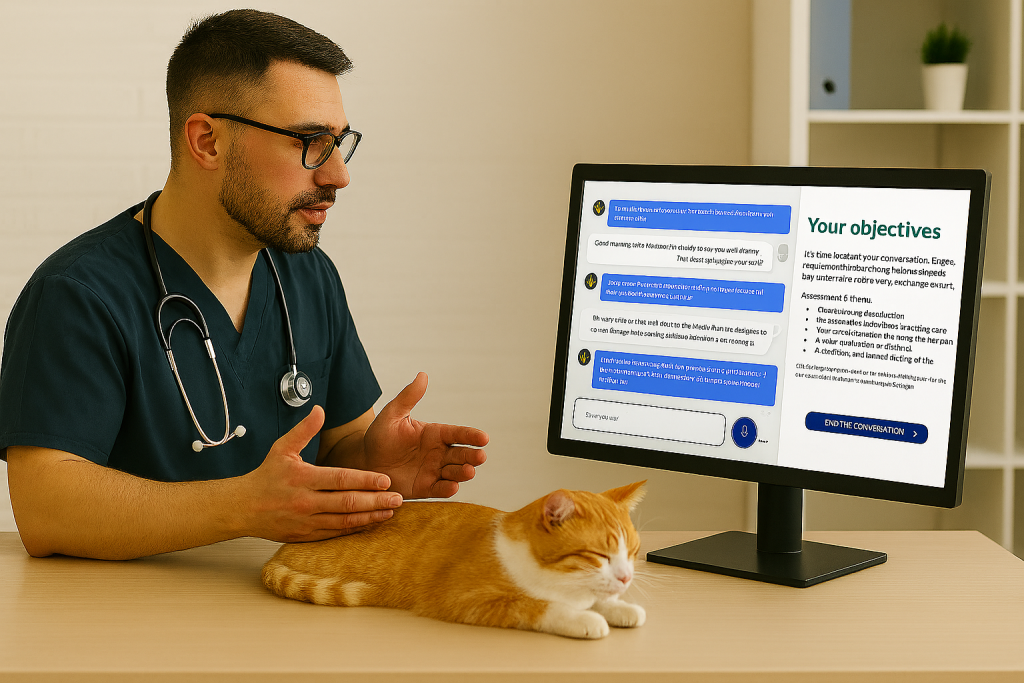
In animal health, organisations invest heavily in training. Veterinarians, vet nurses, marketing directors, technical managers, and field teams regularly attend programmes on communication, client interaction, and team leadership.
Yet despite these efforts, one key challenge remains: Why does training so often fail to translate into sustained real-world behaviour?
The answer is simple but often overlooked: Learning doesn’t fail during training. It fails after training.
From knowledge to behaviour: the real gap in training
Most training programmes are designed to transfer knowledge:
- Communication frameworks
- Questioning techniques
- Active listening
- Empathy models
Participants understand these concepts, and even practice with generic scenarios. But when they return to client consultations, difficult conversations, or high-pressure interactions, they struggle to apply them.
Why? Because one-time learning doesn’t create behaviour change.
Why soft skills training fails without practice
Soft skills – communication, leadership, and client interaction – are behavioural skills. They are not learned through a single training event, and a few generic examples.
These skills require:
- Repetition
- Experimentation
- Feedback
Without practice in the real world, even experienced professionals fall back on instinct, especially in stressful situations. One-off workshops or theory-heavy sessions rarely result in lasting change.
The role of practice in learning and development
Practice is how real skills are built. Consider clinical training in human or veterinary medicine: “never the first time on a living patient.”
Veterinary professionals follow this principle for technical skills like surgery:
- Practicing in realistic conditions
- Learning from mistakes
- Receiving feedback
- Repeating until confident
Only then are they ready to perform in real clinical settings.
Yet when it comes to communication, leadership, or client interaction, this principle is often overlooked. And still, the same reality applies. These are skills performed under pressure, in complex human situations. They require practice just as much as clinical procedures do.
Because ultimately, behaviour does not change through understanding alone: it changes through experience, repetition, and feedback.
What makes learning stick in animal health
1. Realistic learning environments
Training must reflect real-world conditions, including:
- Emotional client interactions
- Time pressure
- Complex decision-making
The closer the learning experience is to reality, the higher the likelihood that skills transfer to the workplace.
2. Repetition and active learning
Behaviour change requires multiple attempts. Professionals need opportunities to:
- Try different approaches
- Refine communication techniques
- Build confidence
One session is never enough.
3. Safe spaces to practice
Learning is most effective when mistakes are consequence-free. Professionals need environments where they can:
- Experiment with new behaviours
- Receive immediate feedback
- Build confidence gradually
Without psychological safety, learning remains superficial.
The challenge of scaling practice in animal health
Despite its importance, practice is often hard to implement. Common barriers include:
- Limited time for training
- Discomfort with role-play
- Lack of realistic scenarios
- Limited coaching resources
As a result, learning often remains conceptual rather than practical.
How AI is transforming soft skills training
AI-powered tools are helping professionals overcome these barriers by:
- Simulating realistic conversations
- Providing instant feedback
- Allowing repeated practice anytime
- Building confidence for real interactions
While AI cannot fully replicate body language or human nuance, it prepares learners by removing some complexity, allowing them to focus on verbal skills first. This makes subsequent real-life interactions far more effective.
This focused practice strengthens the verbal foundation of communication. From there, the next step, such as role-play or real-life interaction, becomes significantly easier and more effective, as learners are no longer overwhelmed by both what to say and how to say it at the same time.
AI simulations don’t replace real life training, they prepare and enhance it, making high-quality practice scalable and accessible.
Curious how AI can make your team’s client interactions more confident?
Conclusion: Learning only works if behaviour changes
In animal health, technical expertise is essential, but human skills drive real outcomes. To make learning stick, training must be:
- Practical
- Realistic
- Repeatable
Because ultimately: learning only matters if it changes what people do in the field.
Ready to see your training translate into real-world impact?
👉 Book a 30-minute conversation to see how your training can truly change behaviour